The magic fitness number
Your fitness level - your maximum oxygen uptake - is perhaps the best measure of the health of your body. At Mia Health, we don't just give you a good estimate of your maximum oxygen uptake. We also give you the opportunity to measure it accurately.
Why fitness is so important
Over the past few decades, there has been a long line of research papers showing how important your fitness is to your health. With low maximum oxygen uptake, your quality of life decreases (1) and you are at increased risk of lifestyle diseases (2), mental health problems (3) and dying before your life expectancy (4). In fact, a large body of research shows that poor fitness contributes to far more ill health in the world than smoking, obesity and unhealthy levels of sugar and fat in the blood (5).

Indispensable oxygen
Actually, it's not surprising that this is the case. The cells in our body need oxygen to function, and the more oxygen the body can absorb, the better off it is. Our muscle cells need oxygen to be able to produce energy, and the more oxygen that reaches the muscles, the more energy the muscles are able to produce.
A maximum oxygen uptake test can quantify just that: How much oxygen your body is able to absorb and utilize for muscle work every minute at maximum exertion. The result is expressed in the number of milliliters of O2 per kilogram of body weight per minute: ml/kg/min.
The result is often referred to as your fitness number. People with a high fitness number are able to maintain high energy production over a long period of time and thus have good fitness.
Trainable obstacles
On its way from the air to the muscles, oxygen encounters a number of obstacles. First, it has to pass through the lungs and into the bloodstream. A weak heart can prevent oxygen from being pumped efficiently to the rest of the body. The final obstacle on the way to the muscles is the blood vessels, and both stiff blood vessels and a poorly developed network of blood vessels can slow down the flow of oxygen to the muscles.
In other words, your fitness level tells something about the status of many important parts of your body. With the right physical activity, it is possible to improve the function of the heart, blood vessels and muscles (6, 7, 8) - and thus increase your fitness level (9).

Test Your VO₂ Max with Complete Accuracy Using Mia Health
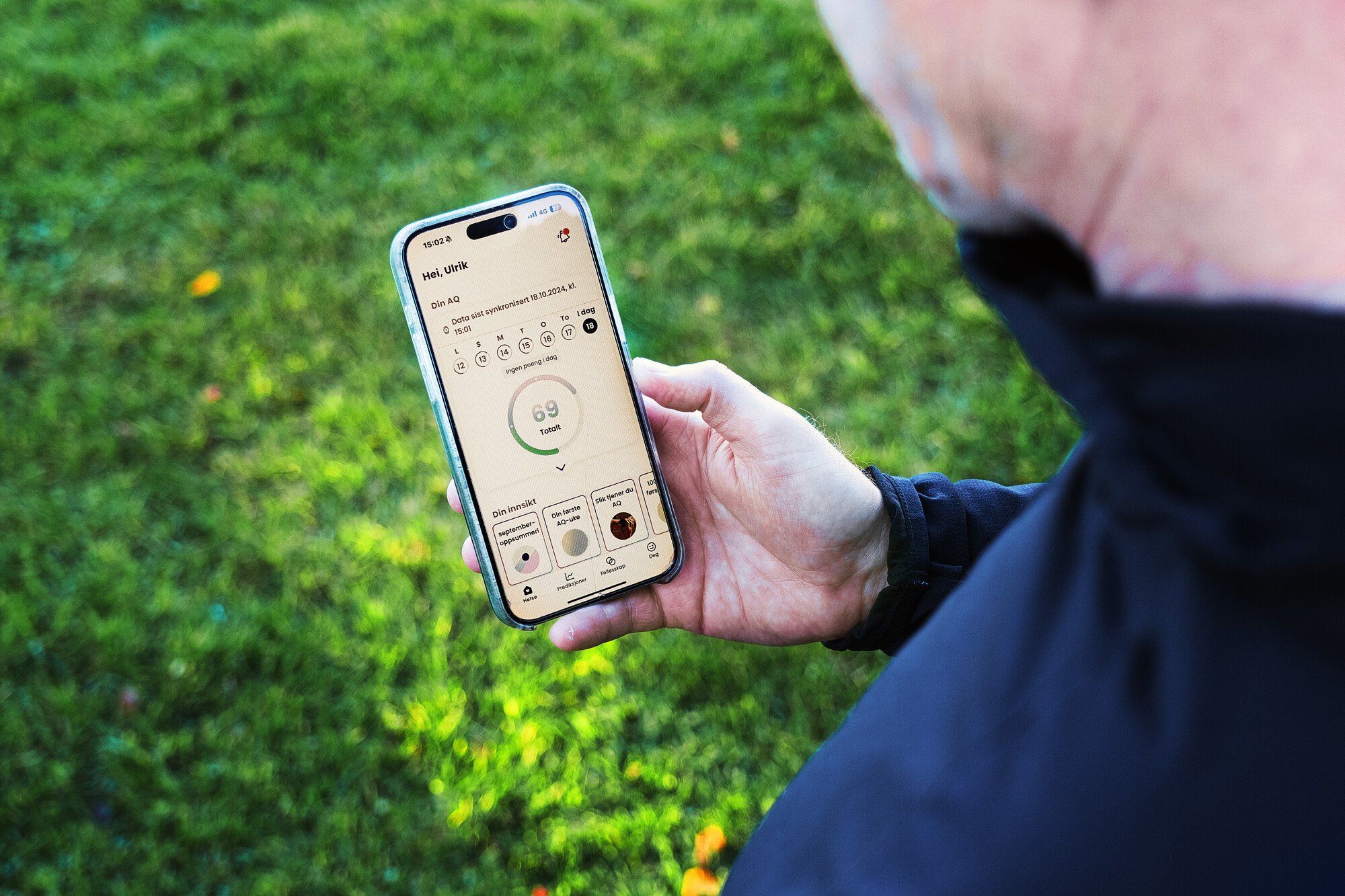
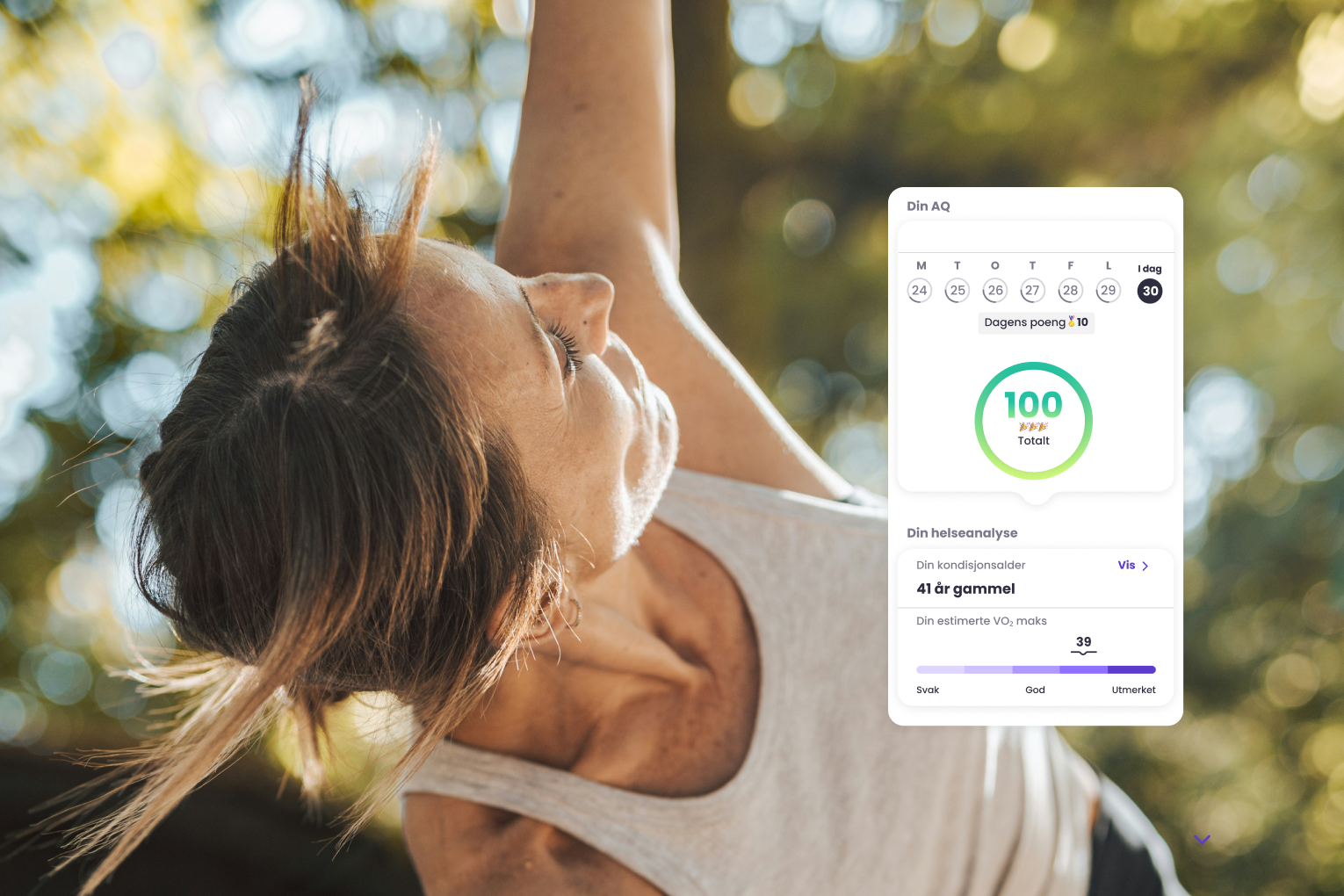
Mia Health gives everyone the opportunity to get a research-based estimate of their fitness score in the app. This is converted into a fitness age, so you can always see how you stack up against others your age.
However, Mia Health also offers even more accurate fitness testing. This means anyone who wants to can find out their fitness score and fitness age with complete precision. The test is equally suitable and beneficial for both untrained and well-trained individuals.
Here’s how it works
Mia Health partners with providers of VO₂ max testing across much of Norway, from Tromsø in the north to Grimstad in the south.
Click here to book a fitness test at a testing station near where you live.
The test itself, which is conducted on a treadmill or exercise bike, proceeds as follows:
- A ten-minute warm-up to get your breathing, heart, and legs going. During the warm-up, we’ll determine how to tailor the test specifically to you, so we can start at a reasonable intensity and gradually increase the workload in the best possible way.
- We’ll help you put on a mask that measures the oxygen level in the air you exhale. This mask does not affect the air you inhale and therefore in no way limits your breathing capacity or your ability to work hard during the test.
- The test itself begins. From the starting load to maximum exertion, the test takes 5–10 minutes. The load is increased slightly every minute. The test ends when you can no longer continue, or when our measurements show that you have reached your maximum oxygen uptake.
More insight and better advice
The exercise physiologists at Mia Health have over ten years of experience with top-notch fitness testing. We’ve tested everyone from elite athletes to seriously ill heart patients, and we specialize in designing the test in a way that feels safe and manageable for everyone.
The results from a VO₂ max test with Mia Health can be entered directly into the Mia Health app, so your fitness age is updated automatically. With our precise measurements, you can gain even better insight into your own health—and receive lifestyle advice that’s even better tailored to you and your situation.
Mia Health has also partnered with quality-assured testing providers across much of the country. This means we can offer you a Mia Health-approved VO₂ max test almost anywhere in Norway.
Click here to book a fitness test at a testing center near where you live.
Kill two birds with one stone
A VO₂ max test will help you determine your maximum heart rate with complete accuracy. Maximum heart rate is used, among other things, to calculate your AQ precisely.
In other words, with a VO₂ max test from Mia, you can kill two birds with one stone:
- 100% accurate fitness age in the Mia Health app
- 100% accurate calculation of your AQ in the Mia Health app
Note! You can also perform a reliable maximum heart rate test on your own. On our webpage about maximum heart rate, we show you how.
References:
- Sloan, R. A., Sawada, S. S., Martin, C. K., Church, T., & Blair, S. N. (2009). Associations between cardiorespiratory fitness and health-related quality of life. Health and Quality of Life Outcomes, 7(1), 1–5.
- Kaminsky, L. A., Arena, R., Ellingsen, Ø., Harber, M. P., Myers, J., Ozemek, C., & Ross, R. (2019). Cardiorespiratory fitness and cardiovascular disease—the past, present, and future. Progress in Cardiovascular Diseases, 62(2), 86–93.
- Kandola, A., Ashdown-Franks, G., Stubbs, B., Osborn, D. P. J., & Hayes, J. F. (2019). The association between cardiorespiratory fitness and the incidence of common mental health disorders: a systematic review and meta-analysis. Journal of Affective Disorders, 257, 748–757.
- Imboden, M. T., Harber, M. P., Whaley, M. H., Finch, W. H., Bishop, D. L., & Kaminsky, L. A. (2018). Cardiorespiratory fitness and mortality in healthy men and women. Journal of the American College of Cardiology, 72(19), 2283–2292.
- Myers, J., Prakash, M., Froelicher, V., Do, D., Partington, S., & Atwood, J. E. (2002). Exercise capacity and mortality among men referred for exercise testing. New England Journal of Medicine, 346(11), 793–801.
- Moreira, J. B., Wohlwend, M., & Wisløff, U. (2020). Exercise and cardiac health: physiological and molecular insights. *Nature Metabolism*, 2(9), 829–839.
- Ashor, A. W., Lara, J., Siervo, M., Celis-Morales, C., Oggioni, C., Jakovljevic, D. G., & Mathers, J. C. (2015). Exercise modalities and endothelial function: a systematic review and dose–response meta-analysis of randomized controlled trials. Sports Medicine, 45(2), 279–296.
- Lim, A. Y., Chen, Y. C., Hsu, C. C., Fu, T. C., & Wang, J. S. (2022). The effects of exercise training on mitochondrial function in cardiovascular diseases: A systematic review and meta-analysis. International Journal of Molecular Sciences, 23(20), 12559.
- Scribbans, T. D., Vecsey, S., Hankinson, P. B., Foster, W. S., & Gurd, B. J. (2016). The effect of training intensity on VO2max in young healthy adults: a meta-regression and meta-analysis. International Journal of Exercise Science, 9(2), 230.

Anders Revdal
24 August 2024